

 Instant Booking
US$ 2037.75.00
16 Days
Everest Regions
March-May/Sep-Nov
Challenging
5,364 m
Trekking
Car | Jeep | Flights
Highlight
- Panoramic Mountain Views: Get awe-inspiring views of Mount Everest, Cho Oyu, Lhotse, Makalu, and other towering peaks of the Himalayas.
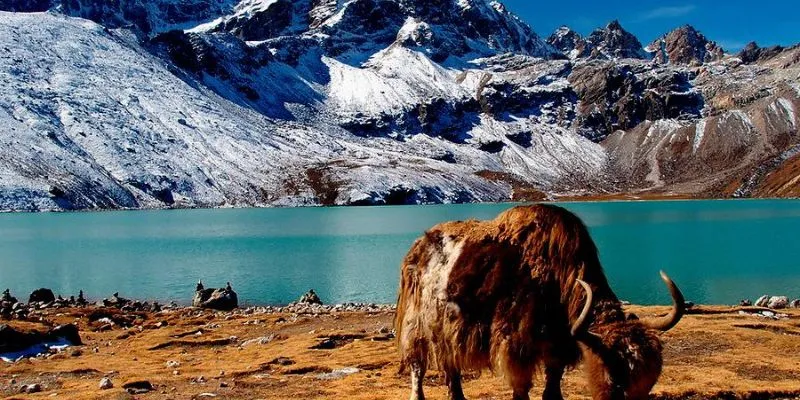
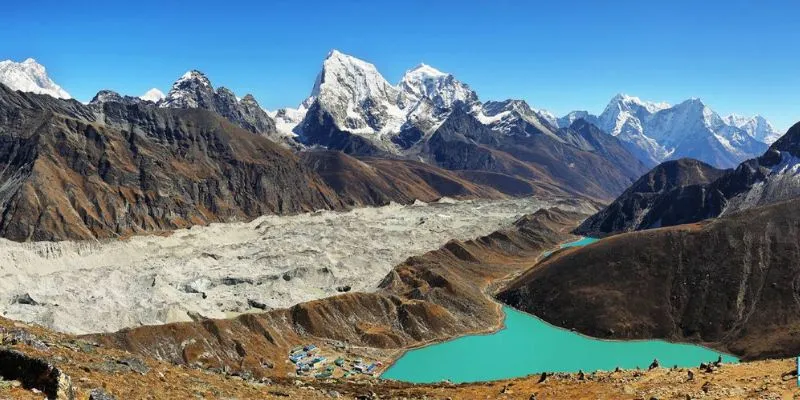
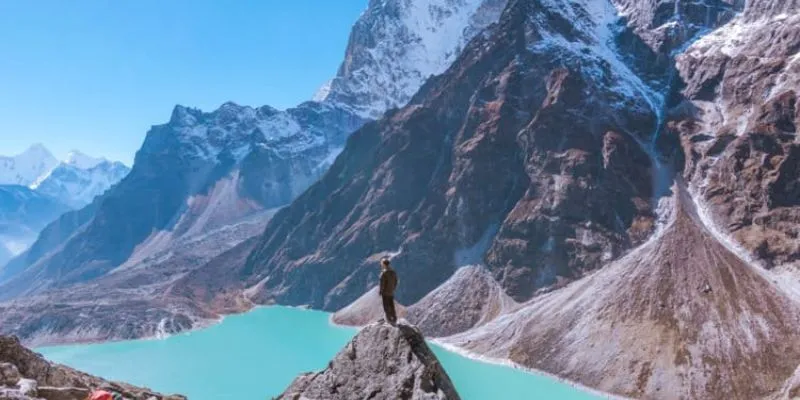
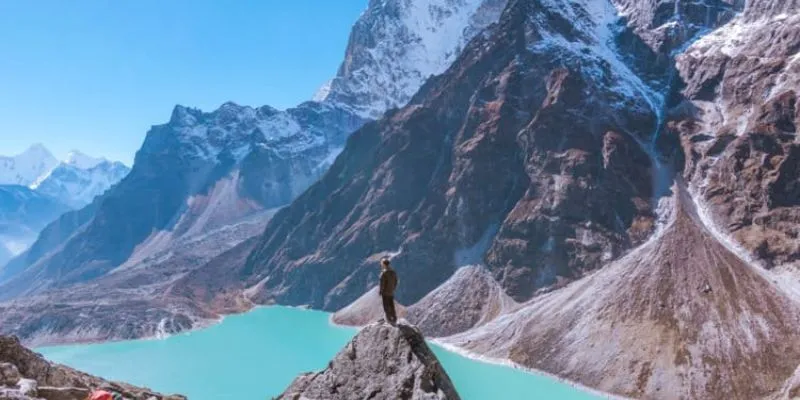
- Gokyo Lakes: Visit the beautiful Gokyo Lakes, known for their stunning turquoise waters surrounded by snow-capped mountains.
- Gokyo Ri Sunrise: Hike to Gokyo Ri for a mesmerizing sunrise view of the Everest massif, including four of the world’s highest peaks.
- Cho La Pass Crossing: Cross the challenging Cho La Pass (5,420 meters), one of the most thrilling high-altitude passes with incredible views of glaciers and peaks.
- Everest Base Camp: Visit Everest Base Camp, a major highlight for any trekking adventure in Nepal, offering an up-close view of the world’s highest mountain.
- Sherpa Culture: Immerse yourself in the Sherpa culture by visiting local villages, monasteries, and experiencing their unique way of life.
- Less Crowded Trails: Enjoy a quieter, less crowded trekking route compared to the Everest Base Camp trek, ensuring a more peaceful and serene experience.
Overview
The Gokyo Lake Trek is an alternative to the traditional Everest Basecamp Trek while still providing the trekker with plenty of stunning views of Everest and overnight stays in the iconic town of Namche Bazaar, the gateway to the Khumbu Region. The route to the Gokyo Lakes is less busy but still affords the trekker an insight into local village life, impressive views of icy rivers and stony, glacier debris, snow-capped mountains, and of course, the dazzling turquoise waters of Gokyo Lakes themselves.
The Gokyo Lakes are actually made up of six bodies of water, or lakes, located at an altitude of 4700 to 5000m in the Gokyo Valley. Gokyo Valley falls within the Sagarmatha National Park area. The lakes are the world’s highest freshwater lake system and have been designated as a Ramsar site (wetlands of international importance) and sacred to both Hindus and Buddhists. And if you need any more testaments to the beauty and importance of this area, Lonely Planet states, “for our money, the Gokyo Valley is the most spectacular in the Khumbu.”
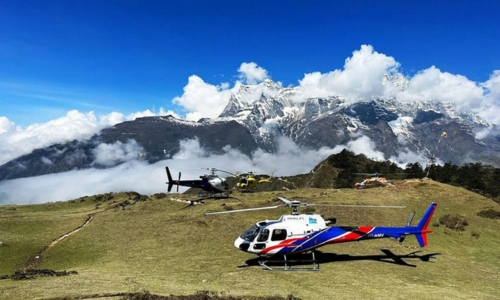
By spending an extra day in the Gokyo Valley, you can visit the 5th and 6th lakes in a high alpine bowl at the foot of Cho Oyu, the world’s 6th highest mountain. You should expect to walk around 5 hours a day, with one of the highlights being a steep climb up to Gokyo RI (5,357m) to\, Cho Oyu, Lhotse, and Makalu. Also on display is the largest glacier in Nepal, Ngozumpa, and ice ridges. If walking 5 hours a day is not an option for you and you still want to see the pristine beauty of Gokyo lake, considering a heli return back is also an option.
To acclimatize before setting off for the Gokyo Ri and Gokyo Valley, time spent in Namche Bazaar offers you the opportunity to trek to nearby Khumjung Village to visit the school set up by Sir Edmund Hillary, who, along with Tenzing Norgay Sherpa, was the first person to successfully summit Mount Everest. Since that time, dozens of climbing expeditions and thousands of trekkers have made Namche Bazaar a vibrant, bustling market town where it is possible to swap trekking stories with members of other groups.
Why Choose the Gokyo Cho La Pass Trek?
- Stunning Views: Get panoramic views of Mount Everest, Cho Oyu, Lhotse, Makalu, and other towering peaks, with some of the best mountain vistas in the Everest region.
- Gokyo Lakes: Visit the beautiful Gokyo Lakes, known for their striking turquoise color and surrounded by dramatic mountain scenery.
- Gokyo Ri Sunrise: Hike to Gokyo Ri for a breathtaking sunrise view of the Everest massif, including four of the world’s highest peaks.
- Cho La Pass Challenge: Cross the Cho La Pass (5,420 meters), one of the most thrilling high-altitude passes, offering spectacular views and a sense of accomplishment.
- Everest Base Camp: The trek includes a visit to Everest Base Camp, one of the highlights of any trek in Nepal, where you can get up close to the base of the world's highest mountain.
- Cultural Experience: Trek through Sherpa villages, visit Buddhist monasteries, and learn about the unique traditions and way of life of the Sherpa people.
- Less Crowded Route: Compared to the standard Everest Base Camp Trek, the Gokyo Cho La Pass Trek is less crowded, offering a more peaceful and serene experience.
Tips for the Trek
- Altitude Acclimatization: The trek involves significant altitude gain, so acclimatization is essential to avoid altitude sickness. Take it slow and allow time for your body to adjust, especially as you approach Gokyo Ri and the Cho La Pass.
- Physical Fitness: The Gokyo Cho La Pass Trek is physically demanding, with several steep ascents, descents, and the challenge of crossing the Cho La Pass. Prior physical preparation is crucial to ensure a successful trek.
- Trekking Gear: Make sure to carry proper trekking gear, including waterproof clothing, insulated layers, trekking boots, and a good quality sleeping bag for high-altitude conditions.
- Weather Conditions: Weather can be unpredictable in the Everest region, especially in the high passes. Be prepared for cold temperatures, wind, and the possibility of snowfall at higher altitudes.
- Hire a Guide and Porter: The Cho La Pass is technically challenging and hiring a local guide and porter can be beneficial for navigation, safety, and to enhance the cultural experience along the trail.
Best Season for Trekking
- Autumn (September to November): The best time to trek, offering clear skies, stable weather, and great views of the mountains. This season also has moderate temperatures, ideal for high-altitude trekking.
- Spring (March to May): Another excellent time for trekking, with moderate temperatures and beautiful rhododendron blooms along the trail, though it can be a bit busier than in autumn.
- Winter (December to February): Winter trekking is possible but challenging due to cold temperatures and potential snow at higher elevations, making the Cho La Pass more difficult to cross.
- Monsoon (June to August): The monsoon season is not recommended due to frequent rain, slippery trails, and the risk of landslides, which can make trekking conditions hazardous.
Conclusion:
The Gokyo Cho La Pass Trek offers a perfect combination of adventure, breathtaking scenery, and cultural exploration. Whether you’re looking for an exciting challenge with high-altitude passes or want to experience some of the best views in the Everest region, this trek provides an unforgettable Himalayan experience.
Additional Information
Coming Soon
Itinerary for Gokyo Lake & Everest Basecamp via Chola Pass
- Upon landing at Kathmandu International Airport, please check for your "Name Plate" at the main gate.
- Our company representative will be there to pick you up and escort you to your hotel in a private vehicle.
- Assistance will be provided for a smooth hotel check-in process.
- If time permits, the representative will take you to our office for a brief trip overview; otherwise, you'll head directly to the hotel.
- Enjoy dinner and overnight stay at a hotel in Kathmandu.
- Take an early morning flight from Kathmandu to Lukla (30–40 min) or from Ramechaap (20 min).
- Begin your trek towards Phakding, descending to Tharo Koshi River (Kusum Kangru Khola).
- Cross the suspension bridge, ascend to Ghat, and continue to Phakding.
- Visit the Gompa in Phakding for your first mountain views.
- Dinner and overnight at a teahouse/guesthouse in Phakding after 3–4 hours of trekking.
- We'll begin the day by trekking along the Dudh Koshi River towards Zamphuti, where you'll enjoy stunning views of Thamserku peak.
- Next, we’ll climb to Chomoa, home to an agricultural project that offers a glimpse into the local farming lifestyle.
- From Chomoa, we ascend to Monjo (Altitude: 2,840m), where we officially enter Sagarmatha (Everest) National Park, established in 1976.
- The trek continues uphill with breathtaking mountain views as we approach Namche Bazaar.
- The trek today will take around 5–6 hours.
- Overnight stay at a hotel in Namche Bazaar (Altitude: 3,420m).
- Today, we'll take a rest day to acclimatize to the high altitude and prevent altitude sickness before continuing the trek.
- We can hike to the Everest View Hotel, offering stunning views of Mt. Everest, Ama Dablam, Thamserku, Lhotse, and other peaks.
- You can explore the Khumjung valley, visit Hillary School, and stop by Khunde Hospital before returning to Namche.
- Spend time in Namche Bazaar, socializing with the friendly Sherpa and Rai people.
- Dinner and overnight at a lodge or guesthouse in Namche Bazaar.
- The trail begins with a gradual ascent to Namche Bazaar, followed by an easy, level walk to Kyangjuma (Altitude: 3,550m).
- From Chor Camp at Namche, you'll enjoy breathtaking views of Mt. Everest (8,848m), Lhotse (8,516m), Nuptse (7,879m), Peak-38 (7,591m), Ama Dablam (6,856m), Taboche (6,495m), and many other peaks.
- The trail then ascends steeply for about an hour and a half to Mongla Danda (3,978m), where you can take a break and admire the stunning view of Mt. Ama Dablam.
- After passing Phortse Thanga, the trail climbs steeply through juniper and rhododendron forests to reach Dole (Altitude: 4,090m).
- Dinner and overnight stay at a teahouse in Dole after approximately 5–6 hours of trekking..
- The trail starts with a gradual ascent to Namche Bazaar, followed by an easy, level walk to Kyangjuma (Altitude: 3,550m).
- From Chor Camp in Namche, you'll be treated to breathtaking views of Mt. Everest (8,848m), Lhotse (8,516m), Nuptse (7,879m), Peak-38 (7,591m), Ama Dablam (6,856m), Taboche (6,495m), and several other peaks.
- Afterward, the trail ascends steeply for about an hour and a half to reach Mongla Danda (3,978m), where you can pause to enjoy a stunning view of Mt. Ama Dablam.
- Continuing from Phortse Thanga, the trail climbs steeply through juniper and rhododendron forests, leading to Dole (Altitude: 4,090m).
- You'll have dinner and stay overnight at a teahouse in Dole after approximately 5–6 hours of trekking.
- Today's route takes you from Machhermo to Gokyo, starting with an ascent up a ridge that offers an outstanding view of the valley leading to Kangtega and the Cho-Oyu mountain range (Altitude: 8,201m).
- Beyond the ridge, the valley opens up as the trail passes through Pangka (Altitude: 4,390m), descending to the riverbank before starting the climb to the Ngozumpa Glacier’s terminal moraine.
- After a steep ascent, you'll reach Longponga, the first small lake (Altitude: 4,650m), where a family of Brahmin ducks has lived for years.
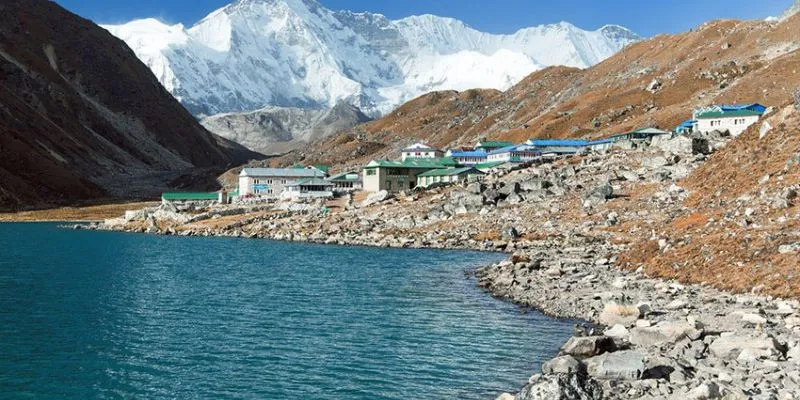
- Passing the second lake, Taujung (Altitude: 4,710m), the trail flattens as it leads to Gokyo Lake (Altitude: 4,750m).
- The trek will take around 4 hours today.
- Dinner and overnight stay at a teahouse in Gokyo
- We'll have a steep ascent to the top of Gokyo RI this morning (Alt. 5357m).
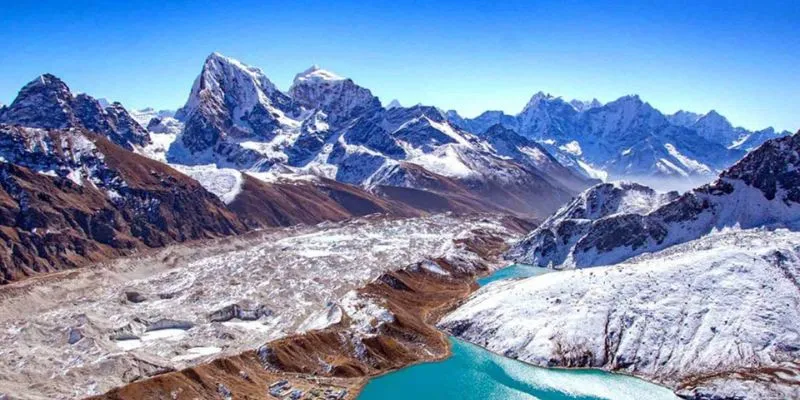
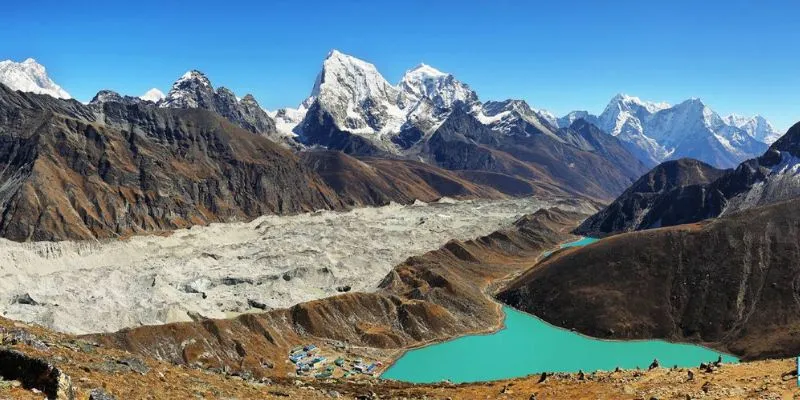
- From there, you can take in breathtaking views of the Gokyo valley, the enormous Ngozumpa Glacier, and a breathtaking panorama of the entire Khumbu mountain range, which includes such enormous peaks as Mt. Cho Oyu (Ht. 8201m), Mt. Everest (Ht. 8848m), Lhotse (Ht. 8516m), Nuptse (Ht. 7879m), Makalu (Ht. 8481m), and Cholaste (Ht. 7922m).
- We will then return to Gokyo (Alt. 4750m) after taking in the breathtaking views at Gokyo Ri.
- The trek from Gokyo Lake to Thakna will take us about 2-3 hours.
- Before taking about 45 minutes to descend along the valley to Thangana (Alt. 4700m), known as the base camp of Cho La Pass, the trail ascends and descends without difficulty through the glacier.
- You will enjoy lovely views of the mountains and other scenic features along the trail.
- The journey from Gokyo Lake to Thagnak is truly wonderful.
- Today’s trek will last approx 4-5 hrs.
- Stay for the night at the lodge in Thagnak.
- Today is one of the most challenging days, with a steep ascent and glacier crossing at Cho La Pass.
- The trail is steep and slippery with glazed rocks, requiring caution as we ascend through a narrow valley from Phedi.
- As we climb, stunning views unfold, including a frozen lake and Cho La Pass (5,368m), adorned with prayer flags.
- You'll see famous peaks like Kyajo Ri, Teng Kang Poche, and Numbur along the way.
- After crossing the pass, we descend steeply to Dzongla (4,830m), passing crevasses and pine forests.
- Dinner and overnight at a teahouse in Dzongla after 7–8 hours of trekking.
- After passing through the Cho La Pass (Alt. 4910m), the distance between Dzongla and Lobuche is short and the trail is easy, so you can take your time and enjoy the trek .
- The trail gently descends and ascends before arriving at Lobuche.
- This trek offers spectacular views of Ama Dablam, Nuptse-Lhotse, Everest, Pumori, and Lobuche.
- Another memorable sight is the sunset over Nuptse from the small village of Lobuche, which is located close to the stream.
- Today’s trek will last approx 2-3 hrs.
- Spend the night at the teahouse in Lobuche.
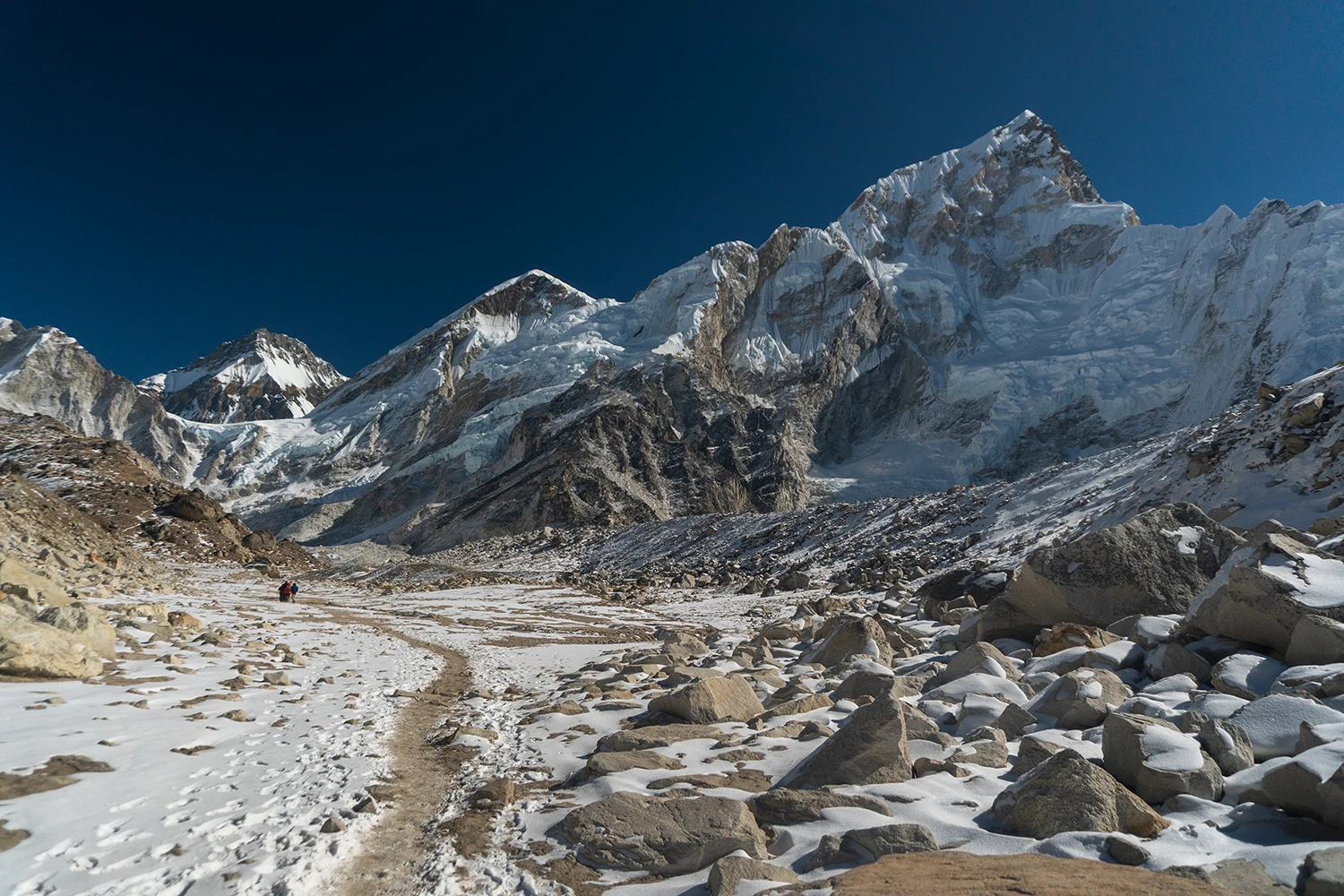
- Today, we'll trek along the Khumbu Glacier until we arrive in Gorakshep. This is the closest village to Everest Base Camp.
- We’ll hike up to Everest Base Camp in the afternoon, where we can views a closest view of Everest.
- Today’s trek might last up to approx. 7-8 hrs.
- We will return to Gorak Shep for the night after ascending Everest Base Camp.
- Early in the morning, we'll hike up to Kala Patthar from Gorak Shep for a stunning view of the many Himalayas and a breath-taking sunrise.
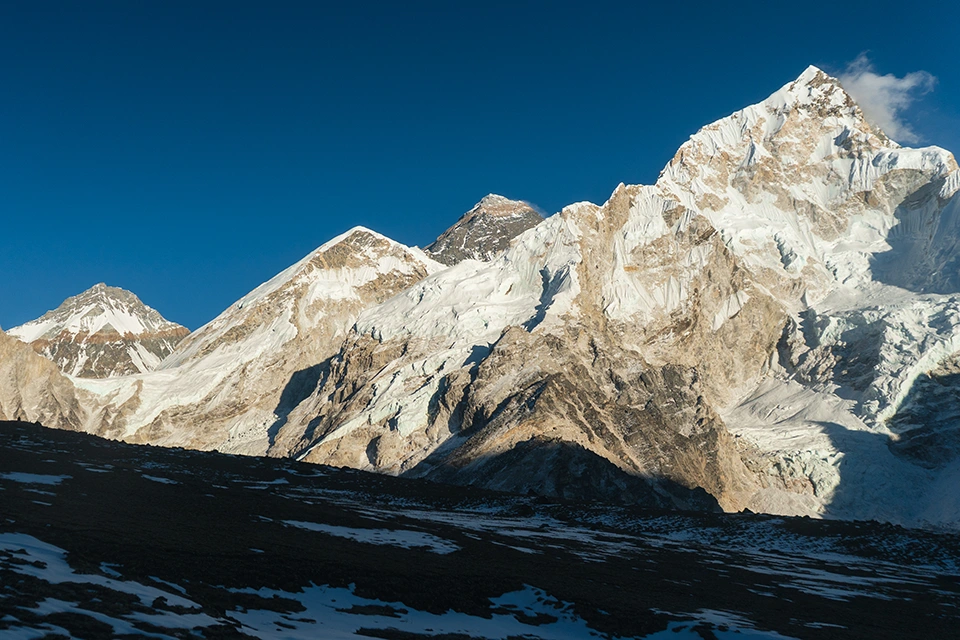
- The Kala Patthar, which translates as "black rock," is the highest point we can hike in Nepal without converting our trekking permit into a climbing permit. The views of Nuptse and Changtse, as well as the up-close views of Everest can be seen from there, which is really extraordinary. The views are breathtaking whenever you hike up here, but sunset and sunrise are probably the best times to do so.
- The trail from Gorak Shep to Kala Patter begins with a steep ascent that lasts for about 30 minutes to get to the flat area where the 2009 cabinet meeting of the Nepal government regarding the issue of global warming was held. It was the first cabinet meeting ever held in such a high location.
- You will finally reach Kala Patthar after the challenging ascent with numerous bends, and it will take another 50 meters of rocky ascent to reach the summit of the main Kala Patthar (5545m).
- Today, you might have a great view of the sunrise over mountains like Mt. Everest (8848), Lhotse (8516m), Nuptse (7879m), Ama Dablam (6856m), Thamserku (6623m), Kangtega (6783m), Kusum Kangaru (6367m), Cholaste (6335m), Taboche peak (6495m), Lobuche peak (6090m), Lingtren.
- We will then trek down through Lobuche and Dughla as we head back to Gorak Shep for breakfast.
- You will cross the river a short distance from Dughla, which originates from the Khumbu icefall and Everest base camp .
- Then you will come across two trails, one of which leads to Dingboche on the left and Pheriche on the right. We will proceed through the left side, which is flat and can be descended smoothly to Dingboche through Dusa to a chorten at the Imja Khola's head.
- Finally, you'll arrive at Dingboche (4410m), where you will spend the night and have your delicious dinner after approx 7-8 hrs of trekking.
- After a delicious breakfast, we will enjoy another relaxing one-and-a-half-hour long walk down a zigzag trail bridge and across a suspension bridge over the Dudh Koshi River.
- When we finally arrive at Kyangjuma, we will ascend stone steps.
- After that, the trail is leveled until it reaches Namche, which takes about 3 hours.
- Spend the night at a lodge in Namche Bazaar after exhausting 7 hrs of trek.
- We set out for Lukla after taking in some stunning views of the mountains in Nepal's Everest region from Namche.
- We travel to Lukla using the same paved route along Jorsale, Monjo, and Phakding.
- The amazing mountainous region and lush forests will keep us motivated for the entire journey.
- Today’s trek will last approx 7-8 hrs.
- Spend the night in a guesthouse in Lukla tonight.
- Today, we'll walk to Tenzing Hillary Airport for your flight back to Kathmandu, or you can fly from Lukla to Ramechaap and then drive to Kathmandu.
- Please note that flights from Lukla typically operate in the morning due to unpredictable weather in the afternoon. If weather conditions delay your return to Kathmandu, we recommend adding an extra day to your itinerary.
- Enjoy a scenic and thrilling 25 to 30-minute flight back to Kathmandu, where you’ll be transferred to your hotel.
- After your long trek through the Himalayas, you'll have some free time to relax and catch your breath, or you can do some last-minute shopping.
- Dinner and overnight stay at a hotel in Kathmandu.
- On this final day, you will receive your trekking permits, TIMS card, and trekking appreciation card as souvenirs from your journey through the Himalayas.
- A representative from our company will drive you to the international airport before your scheduled flight.
- We would greatly appreciate any feedback regarding your Cho La Pass Trek experience or our company, as it helps us improve our services for future customers.
- Depart with wonderful memories of your Himalayan adventure.
- Have a safe flight, and we hope to see you again soon!
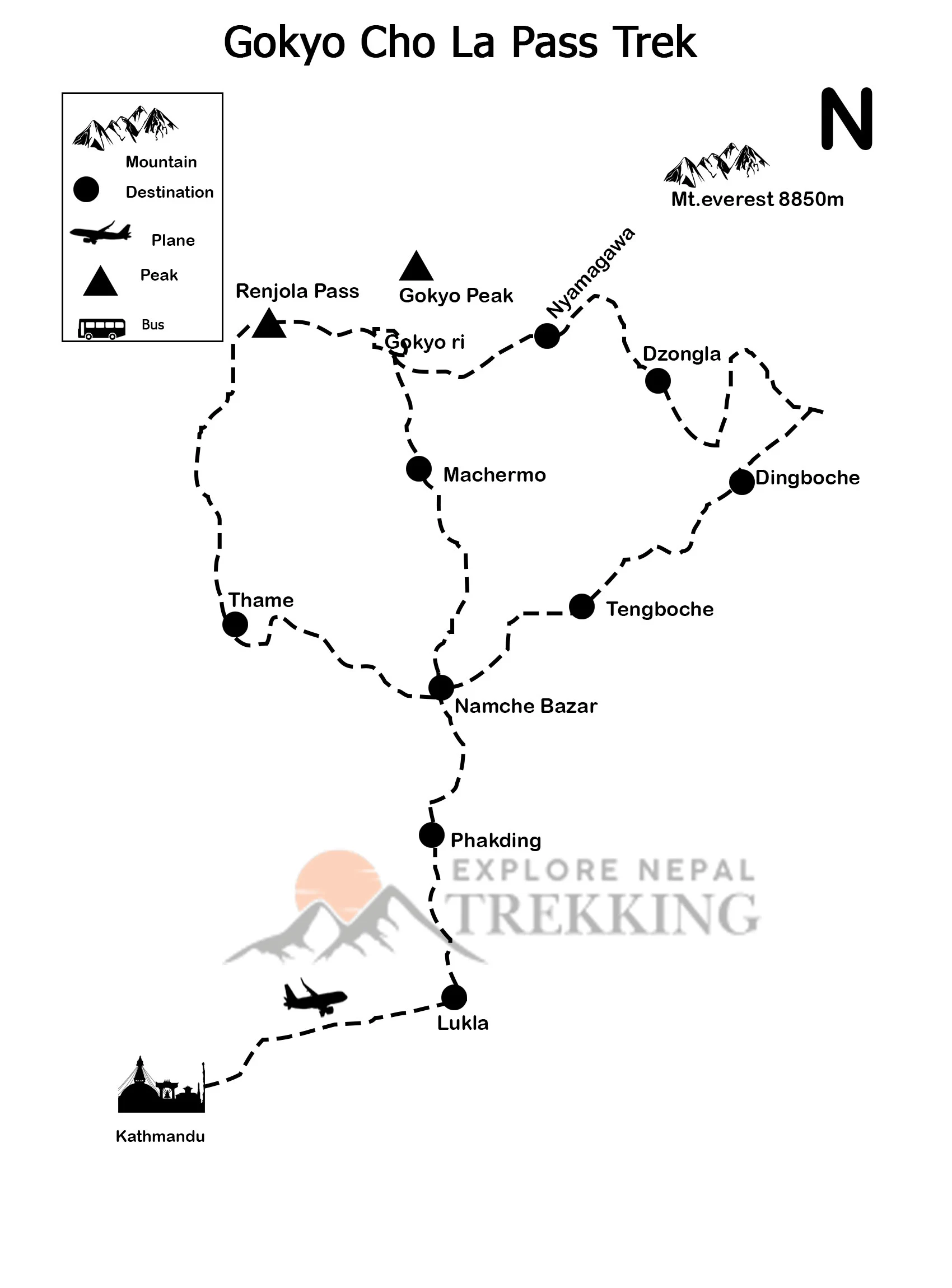
Route Map
Cost Included
- Arrival and departure transport by a private car, van, or bus.
- Three meals a day during the whole trek (breakfast, lunch, and dinner).
- The best possible accommodation during the whole trek.
- An experienced English-speaking trekking guide with his insurance.
- One porter with his insurance.
- Airfare for the flight from Kathmandu to Lukla and back to Kathmandu for the staff, clients, and guide.
- First Aid Kit in case of some small injuries.
- Three nights' accommodation in a 2-star hotel on a bed-and-breakfast basis in Kathmandu.
- Permits for trekking (conservation fees).
- TIMS card (Trekking Information Management System).
- Organizing Helicopter rescue in case of any emergency (Paid by your insurance company or Trekkers themself)
- All the required government fees and taxes.
Cost Excluded
- International airfare (Home country-Nepal-Home country).
- All the meals in Kathmandu (lunch and dinner).
- Your travel insurance.
- Sightseeing entrance fees in Kathmandu.
- Visa to Nepal.
- Any kind of drink or beverage.
- Tips for Guides and Porters.
- Personal expenses like hot showers, battery charges, telephones, etc.
Fixed Departure
| # | Date | Cost | Size | Status | Action |
|---|---|---|---|---|---|
No departures foundTry selecting a different month |
|||||
Equipments
Coming Soon
FAQs Section
The best time to trek the Gokyo Cho La Pass is during spring (March-May) and autumn (October-November). These seasons offer mild temperatures, clear skies, and stable weather conditions, which are ideal for trekking and enjoying panoramic views of the Himalayas. While the winter months (December-February) are less crowded, they bring cold temperatures and snow, making the trek more challenging. The monsoon season (June-early September) is generally not recommended due to heavy rainfall and potential landslides.
The Gokyo Cho La Pass Trek is considered challenging due to its high altitude, steep ascents, and difficult terrain, especially when crossing the Cho La Pass at 5,417 meters. Trekkers should be in good physical condition and have some prior trekking experience, preferably at high altitudes. Acclimatization days are essential to reduce the risk of altitude sickness.
Trekkers need the following permits for the Gokyo Cho La Pass Trek: Sagarmatha National Park Entry Permit: Required to enter the Sagarmatha National Park, where most of the trek takes place. Trekkers' Information Management System (TIMS) Card: This permit is for safety and tracking of trekkers in the Everest region. These permits can be obtained in Kathmandu or Lukla, and it’s advisable to arrange them through a registered trekking agency.
The trek passes through diverse ecosystems, where you can encounter flora such as Birch, Juniper, Rhododendron, and Blue Pines. The region is also home to rare fauna, including the Red Panda, Musk Deer, Himalayan Monal, and Himalayan Tahr. The dense forests and high-altitude areas offer unique opportunities to observe these species in their natural habitat.